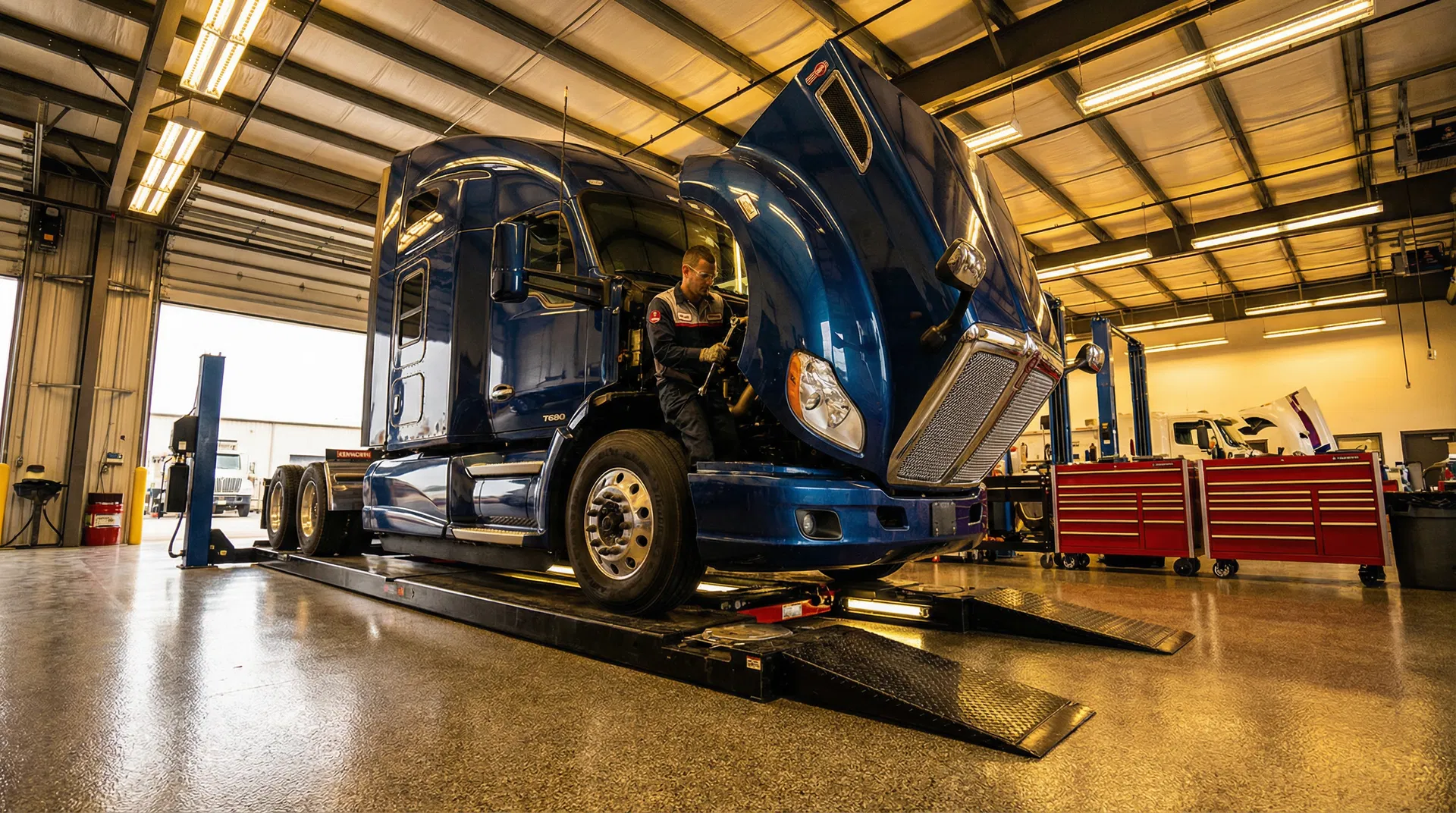
Heavy Duty Brake Repair in Concord, NC
Brake system failures are the number one reason commercial vehicles get placed out of service. At CTR, heavy duty brake repair has been a core specialty for over 30 years. Our ASE-certified technicians service complete brake systems on Class 6 through Class 8 commercial vehicles.
Why Fleet Managers Choose CTR for Brake Repair
Brake system failures are the #1 reason commercial vehicles get placed out of service. Fleet managers need a brake repair partner with the expertise, tooling, and parts inventory to get trucks back on the road safely and quickly.
30+ Years of Heavy-Duty Brake Experience
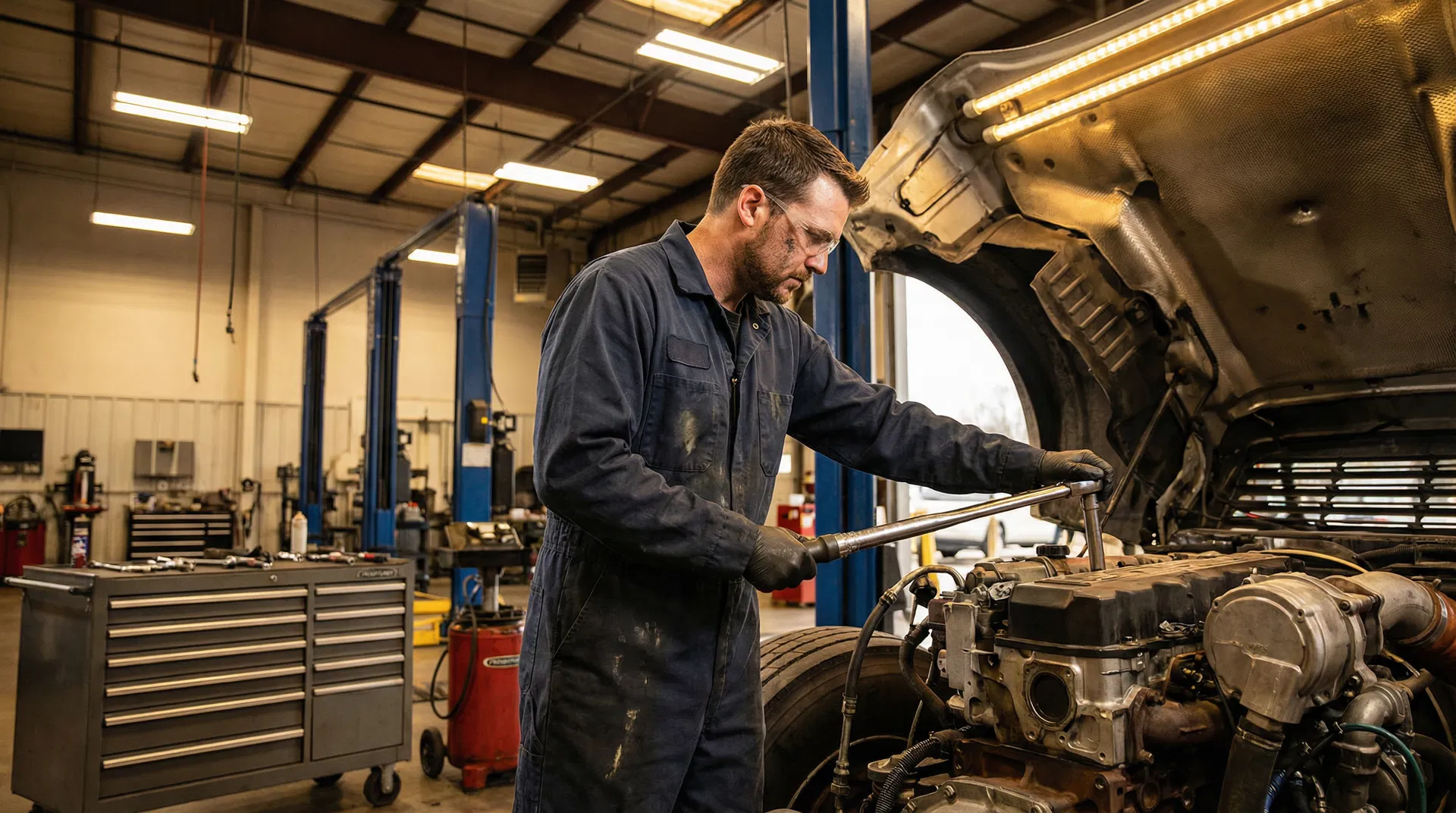
CTR has been servicing air brakes and commercial vehicle braking systems since 1995. Our technicians work on truck brakes every single day — this is not a side service, it is a core competency.
ASE-Certified Technicians
Our heavy duty technicians hold ASE certifications in braking systems and commercial vehicle maintenance. They have the training and hands-on experience to diagnose and repair every brake system configuration on the road.
OEM-Level Diagnostic Capability
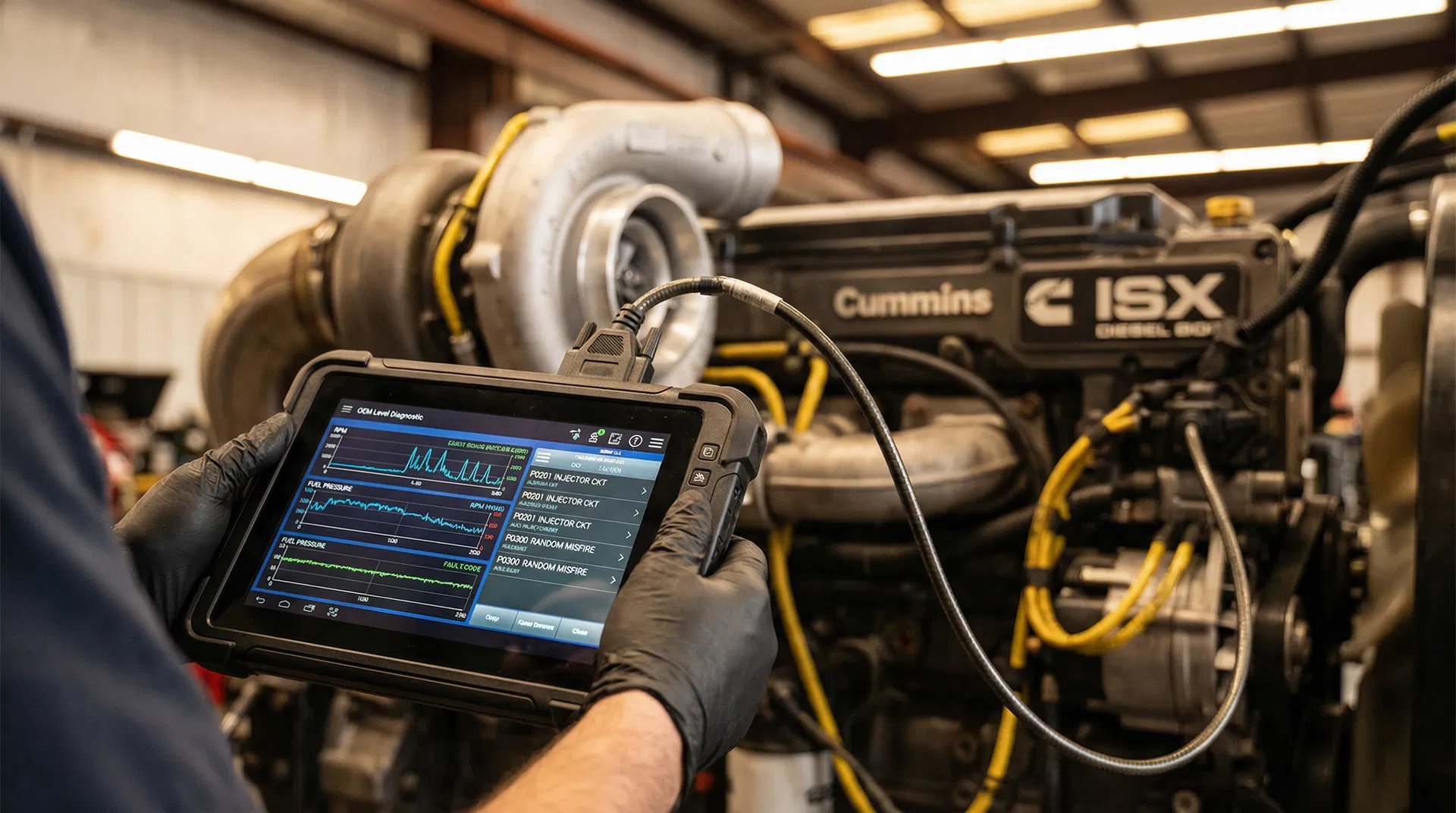
Modern braking systems include electronic ABS, ESC, and integrated chassis management systems that require scan tools and software to diagnose properly. CTR has invested in the diagnostic platforms for all major truck manufacturers.
Same-Day Brake Repair
We maintain inventory of the most common brake components — shoes, pads, drums, rotors, chambers, slack adjusters, and valves — for all major platforms. Most brake repairs are completed same-day.
1-Year, Unlimited-Mile Warranty
Every brake repair at CTR is backed by our industry-leading warranty. When we reline your brakes, replace your chambers, or repair your air system, the work is guaranteed.
DOT-Ready When You Leave
Every brake repair includes post-repair verification against FMCSA standards. We measure pushrod stroke, verify adjustment, test air system integrity, and confirm ABS operation.
Heavy Duty Brake Repair Services
CTR provides comprehensive brake system diagnosis, repair, and maintenance for every commercial vehicle brake configuration on the road.
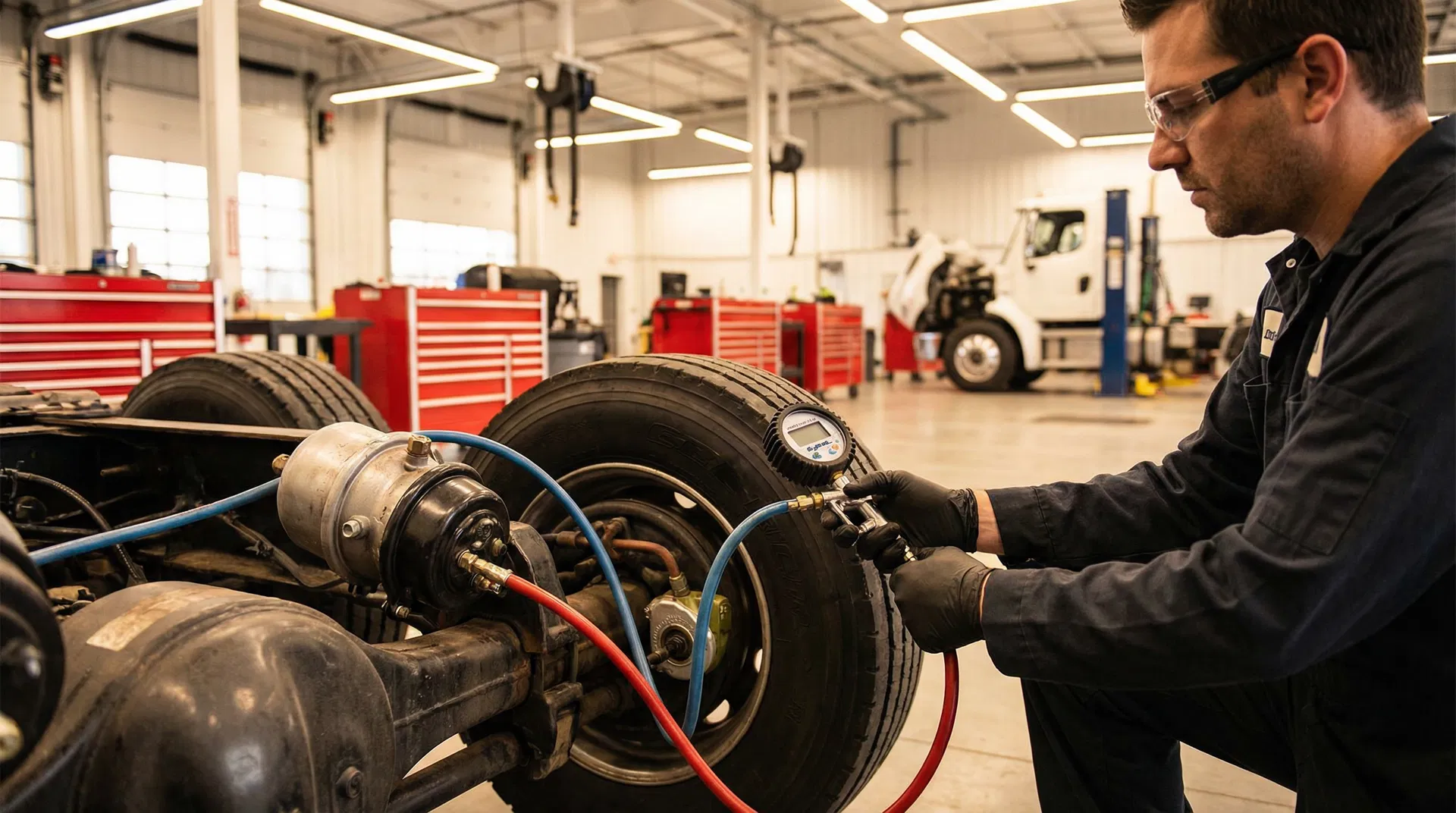
Air brakes are the standard braking system on Class 7 and Class 8 commercial vehicles — a complex pneumatic-mechanical system with dozens of components that must all function correctly for safe stopping.
Air compressor diagnosis, repair, and replacement — including output testing, governor adjustment, and head gasket failures
Air dryer service and replacement — including desiccant cartridge replacement, purge valve repair, and heater circuit testing for cold-weather operations
Air tanks inspection for corrosion, proper mounting, and drain valve function
Brake valves — foot valve (treadle), relay valves, quick-release valves, spring brake modulating valves, and inversion valves
Air lines, fittings, and glad hands — leak testing, replacement of damaged lines, and proper routing verification
Governor adjustment and replacement for proper cut-in and cut-out pressure settings (typically 100 PSI cut-in, 125 PSI cut-out)
Low-pressure warning devices testing and replacement
Spring brakes (parking/emergency) — chamber replacement, manual cage bolt verification, and proper release testing
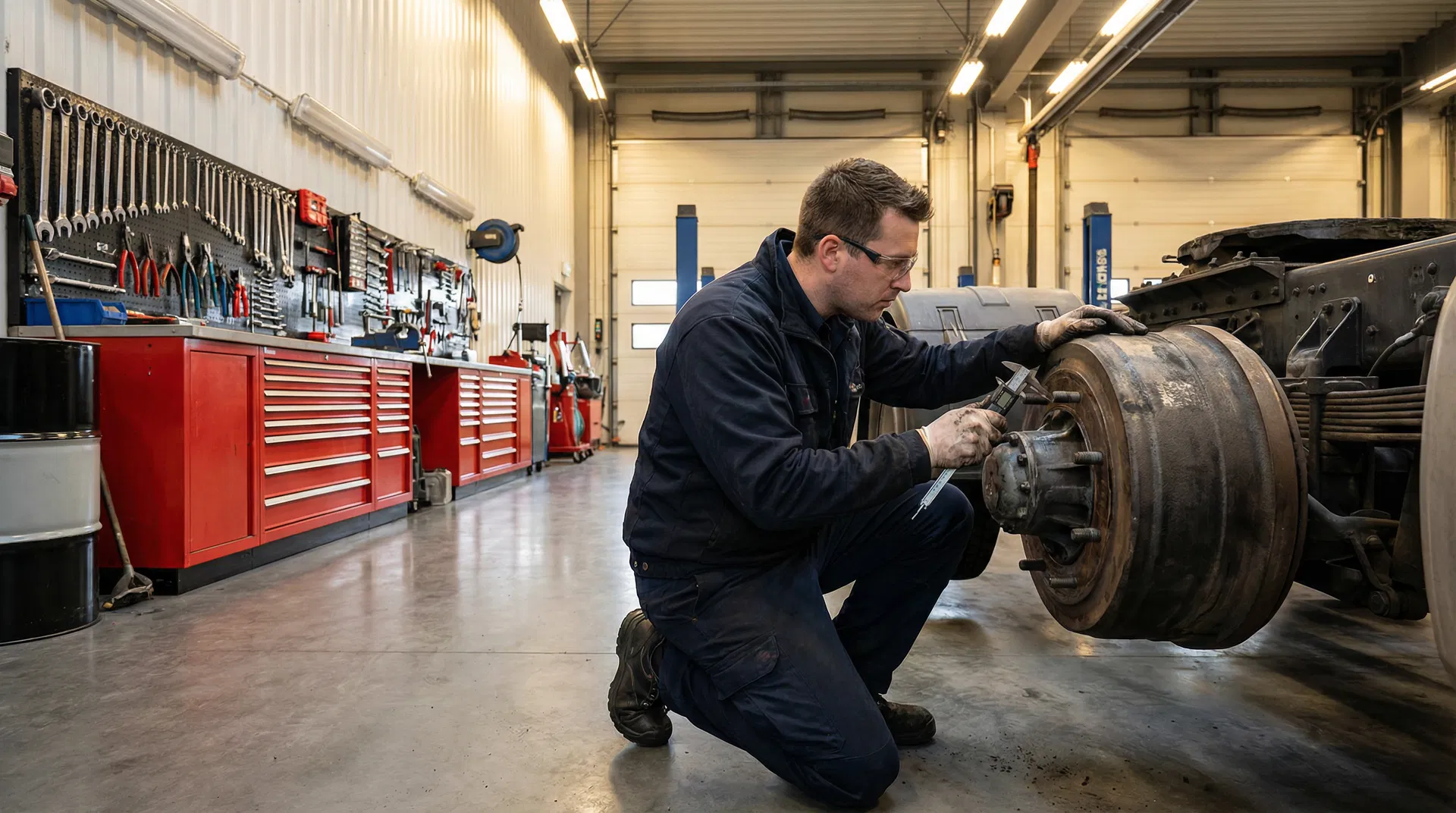
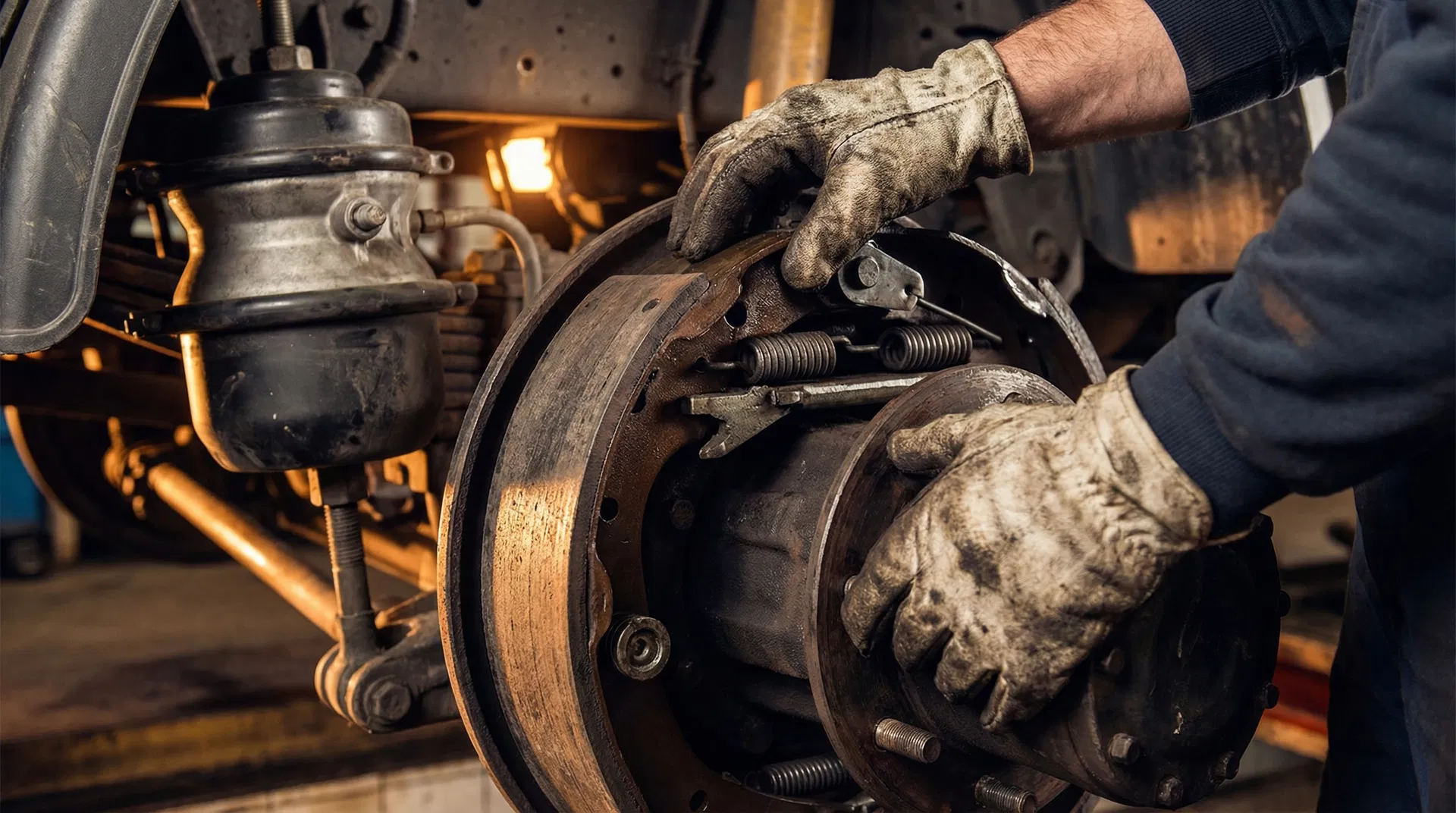
S-cam drum brakes remain the most common foundation brake on commercial vehicles. We service all drum brake components:
Brake drum inspection, measurement, and replacement — checking for heat checking, scoring, out-of-round, and minimum thickness
Brake shoe replacement and relining — using OEM-spec friction material matched to your duty cycle
S-cam bushing and bracket repair — worn S-cam bushings cause uneven brake application and premature lining wear
Cam roller and anchor pin inspection
Return spring replacement
Air disc brakes are increasingly standard on new trucks. We service all disc brake components:
Rotor inspection, measurement, and replacement — including thickness variation (DTV) and lateral runout measurement
Brake pad replacement using OEM-spec friction compounds
Caliper inspection, rebuild, and replacement — including guide pin service, seal replacement, and piston condition
Caliper mounting bracket inspection for wear and proper torque
Improperly adjusted brakes — whether from a failed automatic slack adjuster or manual adjustment error — are the single most cited brake violation during DOT inspections.
Automatic slack adjuster (ASA) diagnosis — verifying proper take-up, internal clutch operation, and adjustment range
Manual slack adjuster measurement and adjustment
Slack adjuster replacement — matching OEM specifications for arm length, spline count, and offset angle
Pushrod stroke measurement and comparison against FMCSA maximum stroke limits by chamber size
Clevis pin and bushing inspection
Brake chambers convert air pressure into mechanical force to apply the brakes. We replace chambers across all axle positions.
Standard service chamber replacement
Long-stroke chamber replacement
Spring brake (piggyback) chamber replacement
Chamber sizing verification for each axle position
Mounting bracket inspection for cracks and proper bolt torque
Every commercial vehicle manufactured after March 1, 1997 (tractors) or March 1, 1998 (trailers) is required to have ABS.
ABS warning light diagnosis using OEM-level scan tools
Wheel speed sensor testing, adjustment, and replacement
ABS modulator valve diagnosis and replacement
ABS ECU (electronic control unit) diagnosis and replacement
Wiring harness repair and connector service
Tractor-to-trailer ABS communication diagnosis (power line carrier systems)
All Major Truck Brands Serviced
Cascadia, M2, Columbia, Century, Classic
T680, T880, W900, T270, T370
579, 389, 567, 348, 337
LT, RH, HV, HX, MV, CV
VNL, VNR, VHD, VAH
Anthem, Pinnacle, Granite, LR, MD
4700, 4900, 47X, 49X
L, XL series
FTR, FVR, F-Series
Signs Your Truck Needs Brake Service
Brake problems rarely appear without warning. Any of these symptoms warrants immediate attention.
Audible Warnings
Grinding, squealing, or metallic scraping during braking
Worn friction material contacting metal-to-metal
Hissing sounds from the brake system
Air leaks in the pneumatic system
Loud "pop" or "bang" when applying or releasing brakes
Failed diaphragm or return spring
Performance Warnings
Increased stopping distance
Worn linings, out-of-adjustment brakes, or air system issues
Pulling to one side during braking
Uneven brake application, sticking caliper, or failed chamber
Spongy/soft brake pedal or delayed response
Air system leak or hydraulic system issue
Truck not holding on grades when parked
Spring brake or parking brake failure
ABS warning light illuminated
ABS system fault requiring diagnosis
Visual & Operational
Slow air pressure build-up or not reaching cut-out
Compressor, governor, or air leak issues
Low air pressure warning buzzer activating
System air leak or compressor failure
Visible brake dust or fluid leaks around wheels
Worn linings or leaking chamber/caliper
Excessive brake drum/rotor heat after driving
Dragging brakes, failed retarder, or over-adjustment
Slack adjusters at or near maximum stroke
Worn linings or failed ASA — visible during pre-trip
The Critical Rule: If a driver reports any brake concern during a pre-trip or post-trip inspection, the vehicle should be taken out of service until the issue is diagnosed and repaired. Operating a commercial vehicle with known brake deficiencies is a violation of FMCSA regulations.
Brake Inspection Standards & FMCSA Compliance
Brake system condition is the single most scrutinized area during DOT roadside inspections. Understanding the inspection criteria helps fleet managers maintain compliance.
FMCSA Maximum Pushrod Stroke Limits
If 20% or more of the brakes on any vehicle in the combination are out of adjustment, the vehicle is placed out of service immediately.
| Chamber Size | Max Stroke (Standard) | Max Stroke (Long Stroke) |
|---|---|---|
| Type 12 | 1.375" | 1.75" |
| Type 16 | 1.75" | 2.0" |
| Type 20 | 1.75" | 2.0" |
| Type 24 | 1.75" | 2.0" |
| Type 30 | 2.0" | 2.5" |
| Type 36 | 2.25" | 3.0" |
Brake Friction Material Requirements
- Lining thickness must not be worn to less than the thickness of the shoe or pad backing
- Linings must not be contaminated with oil, grease, or other substances
- Linings must be properly attached — no loose, cracked, or missing sections
- Drum brakes must maintain proper clearance between lining and drum
Brake System Integrity Checks
- Air leaks anywhere in the system — compressor, tanks, valves, lines, fittings, chambers
- Proper air pressure build-up time (120 PSI in 3 minutes per FMCSA)
- Proper cut-in/cut-out governor pressures
- Spring brake operation and parking brake holding ability
- Brake component damage — cracked drums, scored rotors, broken springs
Air Disc Brakes vs. Air Drum Brakes
The commercial truck industry is gradually transitioning from traditional S-cam drum brakes to air disc brakes (ADB). Here is how they compare:
| Factor | Drum | Disc |
|---|---|---|
| Initial Cost | Lower — drum components are less expensive | Higher — disc brake assemblies cost more upfront |
| Maintenance Cost | Moderate — requires regular adjustment monitoring | Lower over time — self-adjusting, fewer components |
| Stopping Distance | Good | Significantly better — up to 40% shorter stopping distances |
| Brake Fade Resistance | Moderate — heat dissipation limited by drum enclosure | Superior — open rotor design allows faster heat dissipation |
| Pad/Lining Life | Shorter — heat retention accelerates wear | Longer — better heat management extends friction material life |
| Weight | Heavier per axle | Lighter per axle — can add payload capacity |
| DOT Inspection | Adjustment measurement critical — most common violation | Minimal adjustment concerns — fewer OOS issues |
Preventive Brake Maintenance for Commercial Fleets
The most cost-effective approach to brake system management is proactive, scheduled maintenance rather than reactive repair after a failure or DOT violation.
Check for audible air leaks, verify air pressure gauge readings, test parking brake holding, visually inspect for obvious brake component damage
Measure pushrod stroke on all wheel positions, inspect brake linings/pads for remaining material, check for air leaks, inspect drums/rotors for damage, verify ABS warning light status
Comprehensive brake system evaluation including drum/rotor measurement, lining thickness measurement, slack adjuster function verification, air compressor output testing, and air dryer service
Full FMCSA Appendix G brake system inspection
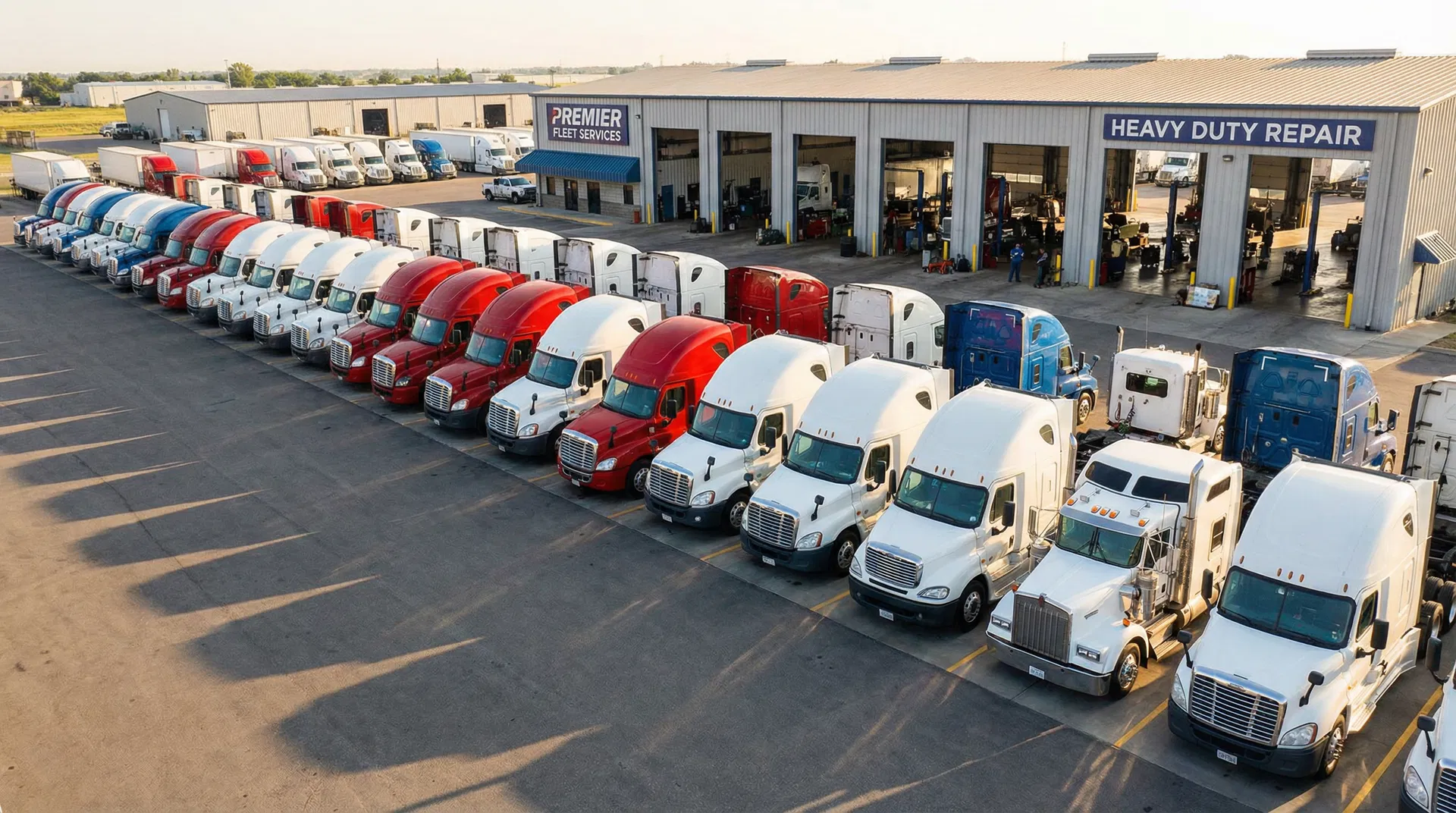
The ROI of preventive brake maintenance is massive. A scheduled brake reline at our shop costs a fraction of an emergency roadside brake failure that requires towing, lost loads, driver detention time, and CSA violations. Fleets that invest in proactive brake maintenance consistently maintain lower CSA Vehicle Maintenance BASIC scores.
Serving the Charlotte Metro & I-85 Corridor
CTR's heavy-duty brake repair shop is located at 2931 Armentrout Drive in Concord, NC — just off I-85 at Exit 58. We prioritize fast, accurate diagnosis and same-day brake repair whenever possible.
We've been here for 30+ years because we do the job right, charge fairly, and treat every customer's truck like our business depends on it — because it does.
Frequently Asked Questions
Look, brake repair costs are all over the place depending on what we're looking at. A basic brake reline — just replacing the shoes or pads on a single axle — typically runs you several hundred to over a thousand bucks including parts and labor. If you need drums or rotors replaced too, you're adding more. A full brake system overhaul on a tractor-trailer — all axle positions, new drums or rotors, new chambers, slack adjusters, the whole package — can run several thousand dollars. But that's a comprehensive job that's going to keep your truck compliant for a long time.
Here's what we do at CTR: we diagnose first, then we give you a detailed estimate breaking down every part and every hour. You see exactly what needs repair, why it needs repair, what it costs, and how long it takes. No surprises, no padding the invoice with work you don't need, no pressure to do more than necessary. We treat your truck like it's ours.
The real cost context is this: a scheduled brake reline at our shop is a couple hundred or a couple thousand dollars. A failed roadside inspection can cost you $1,000 to $10,000 in fines, plus the tow bill, lost freight, driver detention time, and CSA violations that jack up your insurance premiums for two years. Do the math on what a preventive visit costs versus a DOT violation.
FMCSA mandates a complete brake system inspection during your annual DOT inspection, but that's the bare minimum. If you want to actually keep your trucks on the road and avoid surprise failures, you need to be checking brakes way more often.
Every single day: Your drivers need to be checking brakes during pre-trip and post-trip inspections. They should listen for hissing air leaks, watch the air pressure build on the gauge, test the parking brake on a grade. A driver who knows their truck's normal brake feel and air pressure behavior will catch problems early.
Every PM service and oil change: This is critical. Every time a truck comes in for routine service, we measure pushrod stroke on all wheel positions, look at friction material thickness, check the air system for leaks, and verify the ABS warning light isn't lit. This is where most brake violations get caught and fixed before they become roadside problems.
Every 50,000 to 100,000 miles: Run a comprehensive brake evaluation — drum or rotor measurement, full lining thickness check, air system integrity test, and slack adjuster function verification. We see a lot of fleets on the I-85 corridor running hard miles, and this interval catches wear before it becomes critical.
Annually: Full FMCSA Appendix G brake inspection as part of your DOT inspection.
Fleets that do this routine inspection work — the brake check at every PM, the annual DOT inspection, the regular measurements — they catch issues before they reach out-of-service thresholds. They avoid emergency roadside failures. They keep their CSA scores clean. That's the difference between a fleet that's managing costs and a fleet that's taking hits.
We see the same issues over and over again at our Concord shop. The number one problem by far is brakes out of adjustment — it's the leading cause of DOT violations and out-of-service orders. A failed automatic slack adjuster or manual adjustment drift sneaks up on you, and the next roadside inspection puts the truck down.
Worn brake linings and pads are constant. The harder you run — heavy loads, mountain grades, stop-and-go delivery routes on the I-85 corridor or around the Charlotte metro — the faster your linings wear. We're rebuilding friction material that's worn down to the backing plate at least two, three times a week.
Air leaks are everywhere in these systems. Leaks in the lines, bad connections at the glad hands, corroded valve bodies, worn chamber seals. Sometimes the air pressure just bleeds down over a few hours, sometimes you get a slow hiss that nobody notices until the truck's struggling to build air on a cold morning.
Brake imbalance happens when one side or one axle position isn't holding its share of the braking load. You feel it as pulling to one side. It causes uneven wear and accelerates the failure of the weaker side.
Overheated brakes show up on trucks running mountain grades without engine braking, or with a failed retarder. The drums or rotors get so hot they fade and lose stopping power.
ABS faults usually mean a wheel speed sensor is bad, or the modulator valve is sticking. We see this on newer trucks that have been in minor accidents that damaged a sensor harness.
Spring brake issues — failed diaphragms inside the parking brake chamber — are serious because that's your emergency brake. You catch one of those on a pre-trip, the truck's done until it's fixed.
Turnaround time is one of the biggest questions I get, and the honest answer is: it depends on what's wrong.
Simple brake adjustment? That's 30 minutes to an hour. Straightforward single axle brake reline, where we're just replacing shoes or pads, is usually 2 to 4 hours. If we're doing a complete reline on all axle positions — tractor and trailer — that's 4 to 8 hours. Add drum or rotor replacement to that and you're looking at 6 to 10 hours.
Air system repair — finding and sealing a leak, replacing a valve, fixing a bad line — that's 1 to 4 hours depending on where the problem is. Brake chamber replacement usually runs 1 to 2 hours per chamber. A complete brake system overhaul, where we're doing multiple axles and replacing chambers and adjusters and linings, that's typically 1 to 2 business days.
ABS diagnosis and repair depends on what's broken — a wheel speed sensor might be a couple hours, but a modulator valve might take longer.
Here's what matters to you: most of the brake work we see — the relines, the adjustments, the common repairs — we get done same-day. We maintain inventory on the most frequently needed parts for all the major truck platforms, so we're not sitting around waiting for a drum or chamber to ship. We get you an estimate, you approve it, and in a lot of cases your truck is rolling the next morning.
This is a big transition happening in the industry right now, and understanding the difference matters because the repair costs, maintenance intervals, and reliability are different.
Traditional drum brakes — S-cam or wedge type — are what most heavy trucks have had for decades. The brake shoes press outward against the inside of a rotating drum. They're proven technology, parts are cheap and widely available, and a good tech can rebuild them in their sleep. The downside is they need regular adjustment monitoring. Out-of-adjustment drums are the number-one DOT violation category. You're measuring pushrod stroke at every PM service. If a truck has been sitting for a month, you check those drums before it rolls.
Air disc brakes are the future, and they're becoming standard on new trucks. Brake pads squeeze against a rotor from both sides — kind of like what you've got on a light truck, but scaled up for heavy duty. They self-adjust by design, so you don't have the adjustment drift problem that kills drum brakes. The heat dissipation is way superior because the rotor is exposed to air, so you get less brake fade on long downgrades. Stopping distances can be 40% shorter. The weight per axle is lighter, which adds payload capacity.
We service both types across all axle positions and all major truck platforms. Disc brakes have lower maintenance costs over time because you're not dealing with adjustment issues and you get better lining life from the superior heat management. But they cost more upfront. Drums are the lower-cost solution initially, but they demand more PM attention.
Older trucks have drums. Newer trucks are going disc. We handle both, and we help customers understand which direction their fleet should go based on their mileage, duty cycle, and long-term ownership plans.
Slack adjusters are lever arms that connect the brake chamber pushrod to the S-cam shaft in a drum brake system. They directly control brake adjustment — the distance the pushrod must travel before the brakes engage. If the stroke exceeds FMCSA maximum limits, the brake is considered out of adjustment and is a violation.
Automatic Slack Adjusters (ASAs) are now required on all commercial vehicles and are designed to automatically compensate for lining wear. However, ASAs can fail — internal clutch mechanisms wear out, corrosion can prevent proper operation. A failed ASA is the root cause of most brake adjustment violations.
At CTR, we test automatic slack adjuster function during every brake inspection — not just the pushrod stroke measurement, but the actual take-up mechanism.
Driver-observable signs: Longer stopping distances, truck pulling to one side during braking, parking brake not holding securely on grades, low air pressure warnings activating more frequently.
Pre-trip inspection checks: Have someone apply the brakes while observing the pushrod extension at each wheel. If the pushrod extends beyond approximately 1.5–2 inches (depending on chamber type), the brake may be approaching the out-of-adjustment limit.
Technical measurement: The definitive way is to measure pushrod stroke with a calibrated stroke gauge while the brake is applied at full system pressure (90–100 PSI).
The best approach for fleets: Include brake stroke measurements in every PM service visit and track the measurements over time.
A DOT brake inspection follows FMCSA Appendix G criteria and includes: pushrod stroke measurement on all wheel positions, friction material thickness assessment, drum/rotor condition evaluation, complete air system integrity testing, ABS verification, spring brake testing, and inspection of every brake component from the compressor through the foundation brakes. Violations are recorded in the federal CSA system.
Yes. CTR services brake systems on all trailer types including van trailers, flatbeds, tankers, dump trailers, lowboys, reefers, and specialty trailers. Common trailer brake issues include corroded glad hand seals, damaged air lines, moisture contamination in trailer air tanks, and neglected brake adjustments.
If 20% or more of the brakes on any vehicle in the combination are out of adjustment (exceeding the maximum stroke for their chamber size), the vehicle is placed out of service immediately. For a typical tractor-trailer combination with 10 brake positions, just 2 brakes out of adjustment triggers an OOS order.
Yes. CTR prioritizes brake-related repairs because a truck with brake problems cannot safely or legally operate. We offer same-day brake repair for most common services and maintain inventory of the most frequently needed brake components for all major truck platforms. Contact us at 704-786-0132.
Brake drum cracking is typically caused by thermal stress — repeated heating and cooling cycles that create fatigue cracks in the drum surface. Contributing factors include: drums worn beyond minimum thickness, excessive braking on downgrades without engine brake use, brake imbalance causing one drum to absorb more heat, and contaminated linings causing uneven friction.
Inside the ASA is a one-way clutch mechanism. Each time the brake is applied and released, the ASA senses whether the pushrod stroke has increased beyond a set point. If it has, the internal clutch engages on the return stroke to advance the worm gear, which rotates the S-cam slightly further, moving the brake shoes closer to the drum.
Important: FMCSA regulations prohibit manually adjusting an automatic slack adjuster as a repair. If an ASA is not maintaining proper adjustment, it must be replaced — not forced into position.
ABS diagnosis requires systematic troubleshooting: fault code retrieval with OEM-level scan tools, physical inspection of wheel speed sensors and tone rings, sensor output testing, modulator valve active testing, wiring continuity and resistance testing, and road test verification. For trailer ABS, we also test the power line carrier (PLC) communication system.
Brake fade is a reduction in braking effectiveness caused by excessive heat buildup. Prevention strategies: Use engine braking on long downgrades, maintain proper brake adjustment, replace linings before they are worn excessively thin, ensure proper drum/rotor condition, consider upgrading to air disc brakes, and verify auxiliary braking systems are functioning properly.
Yes. CTR offers structured brake maintenance programs including: scheduled brake inspections integrated with PM intervals, brake stroke measurement tracking, proactive component replacement, volume parts pricing, priority scheduling, and compliance documentation for DOT audits. Contact us at 704-786-0132 to discuss a fleet brake maintenance program.
A single brake drum for a standard Class 8 application ranges from $80–$200+ per drum depending on brand and specification. Labor to remove the wheel end, replace the drum, and reassemble ranges from 1–2 hours per wheel position. We recommend replacing drums in axle pairs and also replacing the brake shoes, return springs, and inspecting slack adjusters at the same time.
Yes. CTR diagnoses and repairs engine brake systems on all major engine platforms including Jacobs Engine Brake systems on Cummins, PACCAR, and International engines, Detroit Diesel proprietary compression brake systems, Caterpillar compression brake systems, and Pacbrake and other aftermarket exhaust brake systems. A properly functioning engine brake significantly extends the life of your service brakes.
Brake violations are serious — they trigger out-of-service orders that ground the truck immediately. If you catch a violation during an inspection, call us right away at (704) 786-0132. For brake adjustment, reline, or slack adjuster issues, we can often have you road-legal within hours. We prioritize brake work because we understand the revenue impact of a grounded truck on your operation.
Yes — properly relined brakes with OEM-quality friction material will perform identically to new brakes. The key factors are the quality of the friction material, proper installation with correct hardware, and proper adjustment and break-in. We use premium friction materials and follow OEM installation procedures. After reline, brakes need a gentle 50-mile break-in period before full power is achieved.
On trucks with hydraulic brakes (some box trucks, older medium-duty vehicles), leaks originate from: master cylinder or brake booster seals, wheel cylinder seals (drums), caliper seals (discs), brake hoses with cracks or separation, fitting connections, and the proportioning valve. A single drop per second adds up to significant fluid loss. We locate every leak and repair it — never just top off fluid without fixing the source.
Don't Wait for a DOT Officer to Tell You
Don't wait for a driver to report that stopping distances are getting longer. Contact CTR today to schedule your heavy duty brake repair.