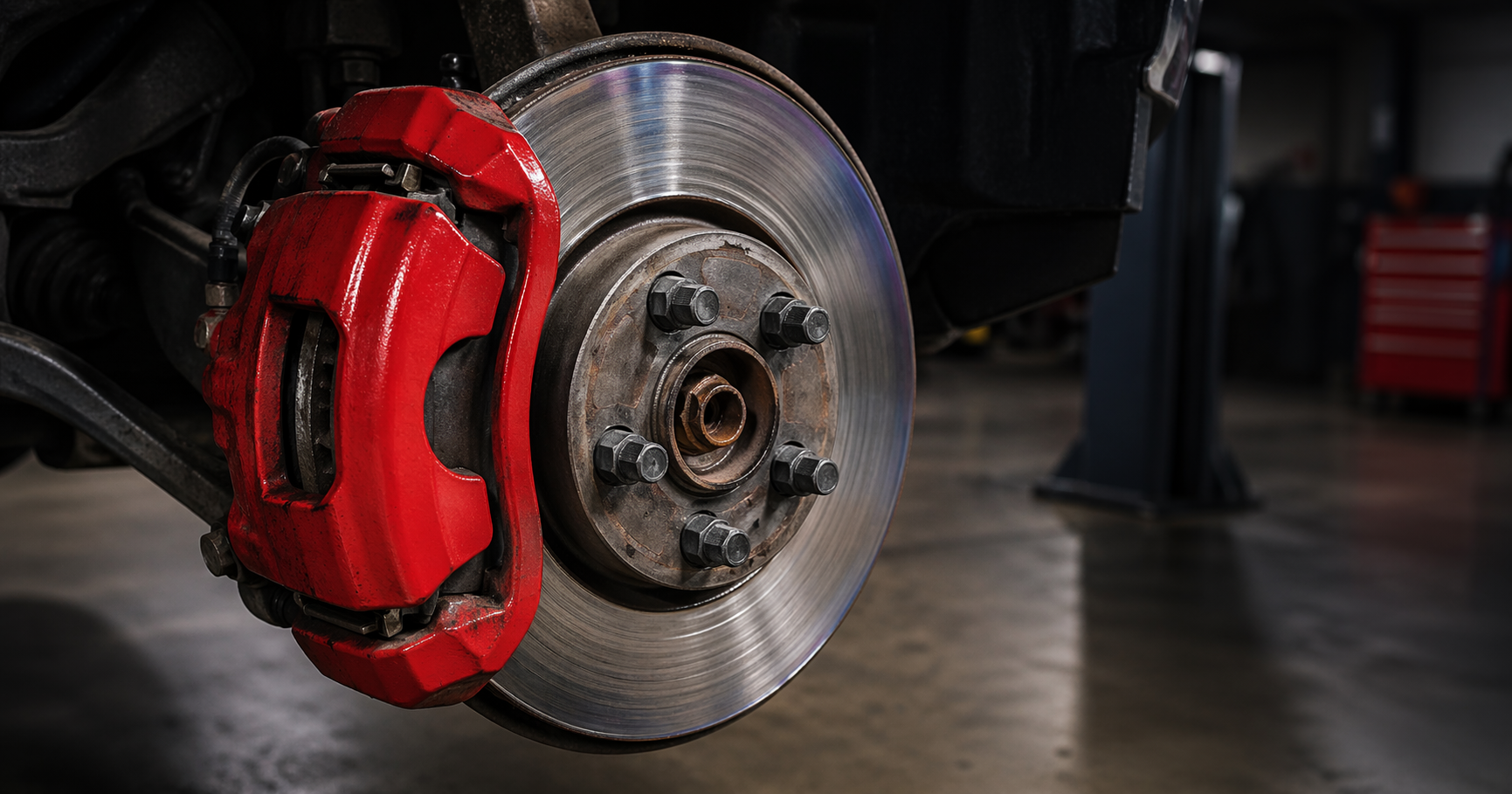
Your brakes are one of the most important safety systems on your vehicle. They're also pretty good at telling you when something's wrong — if you know what to listen for.
I've had customers roll in after ignoring brake noises for months, turning what could have been a $400 brake pad and rotor job into a $1,200 mess because they let it go too long. The grinding sounds? That's metal on metal. The damage doesn't stop at the pads. It's scoring the rotors, heating up the caliper, sometimes even getting into the wheel bearing or hub. That's when the bill gets expensive.
Here's what you need to know about the sounds and feelings your brakes are throwing at you.
Before I get into the warning signs, it helps to understand what's actually happening when you press the brake pedal. That photo above? That's a disc brake assembly — exactly what's on the front of most cars and trucks. You've got the rotor (the big silver disc), the caliper (the red housing), and the brake pads inside the caliper. When you step on the pedal, hydraulic fluid pushes the caliper, which squeezes the pads against the spinning rotor. That friction is what slows you down. When any of those parts wear out or fail, your brakes let you know.
Brake Pad Wear Stages
How your brake pads deteriorate over time
 CTR Repair — Concord & Kannapolis, NC
1. High-pitched squeaking (the early warning)
A light, high-pitched squeak is almost always an indicator that your brake pads are getting thin. Most brake pads have a little metal tab built into them — a wear indicator. When the pad gets down to a certain thickness, that tab starts rubbing against the rotor and making noise.
This is actually the brake system doing its job. It's the equivalent of your check engine light, except it sounds like a bird in the morning.
Should you panic? No. Should you schedule a brake inspection within the next week or two? Yes. You've got some time, but your brakes are in the last 20% of their life. Don't keep driving around ignoring it.
2. Grinding sound (stop, don't pass go)
Grinding is different. That's a rough, almost crunching sound that sounds like metal scraping on metal. That's because it is.
Your pads have worn through completely. You're bone on rotor. Every time you hit the brakes, you're increasing the damage. This is the point where you need to get to a shop, and I'd recommend sooner rather than later.
This is where that customer I mentioned came in. He'd been hearing the grinding for three months. "It still stops fine," he said. Yeah, it does. For now. But he ended up needing new rotors, new pads, new hardware, and his caliper wasn't happy either. One brake application at 60 mph would've been safer than three months of grinding.
What Waiting Actually Costs You
Same vehicle, same brakes — timing changes everything
Average brake pad + rotor replacement
Pads + rotors + calipers + hardware + labor
3. Soft or spongy pedal (air in the line)
If your brake pedal feels like you're pushing into a sponge, like it goes down further than it should before the brakes engage, that usually means there's air in your brake lines or a leak in your hydraulic system.
This one you don't want to mess with. Brakes are hydraulic. No fluid, no stopping power. We see this sometimes with older vehicles or if somebody's had recent work done on the system and there's still air trapped in the lines.
Get it looked at soon. You might just need a brake bleed, or you might have a slow leak somewhere. Either way, it needs attention.
4. Brake pedal goes to the floor (real emergency)
If you step on the brake and it goes all the way to the floor with no resistance, you've got a serious problem. Total brake fluid loss or a major leak. Don't drive it. Call us. You've got no stopping power.
This is rare, but when it happens, it's time to take it seriously. We had a guy on Zion Church Road a few months back — his brake line rusted through. He noticed the pedal getting softer and softer over a couple days and brought it in before it got critical. Smart move.
5. Brake fade (mushy braking, especially downhill)
You step on the brakes hard and the pedal stays soft. You have to push harder and harder to get the same stopping power. This can happen if you're braking hard for extended periods — like coming down a long mountain or highway descent.
The brake fluid heats up, it expands, and the system loses effectiveness for a bit. This is usually temporary. But if it happens during normal driving, you might have contaminated brake fluid or a bigger issue.
In heavy-duty work — we do a lot of dump trucks and cement mixers around Kannapolis — this is something we watch for. Repeated heavy braking can break down the fluid faster than normal city driving.
6. Vibration or pulsing when braking
A rhythmic pulsing in the pedal, especially when you brake hard, usually means your rotors are warped. It could also mean your wheel bearings are failing or something's loose. The brake pad surface isn't making even contact with the rotor.
You'll feel it in the pedal and sometimes in the steering wheel if it's a front brake issue. It's not an emergency, but it needs to be addressed. Warped rotors will usually need replacing. Sometimes you can get away with resurfacing them, but not always.
How Urgent Is Your Brake Problem?
Each sign ranked by how quickly you need to act
What I do when I hear a brake noise
Here's my approach. If you call and tell me you're hearing something, I don't try to diagnose it over the phone. I pull the vehicle in and look at it. Sometimes it's nothing. Sometimes you've got one pad worn and three that are fine. Sometimes the noise is coming from something completely different — a wheel bearing, a heat shield, a sticky caliper.
If you want to see what we find, we're happy to send photos. I'll be straight with you about whether it needs to be done today or if you've got some time. And we back everything up with a warranty — 3 years/36,000 miles on auto, 1 year/unlimited miles on heavy-duty. If we do the work, we're responsible for it.
The bottom line
Brakes are the one system on your vehicle where you can't really afford to ignore the warning signs. Your vehicle is telling you something. Listen to it.
A $400 brake job today is a lot better than a $1,200 nightmare because you waited three months. And a lot better for your safety and the safety of everybody else on the road.
If you're in the Concord or Kannapolis area and your brakes are making noise, bring it by. We've got two automotive locations ready to help. We'll look at it, take a photo of what we find, and tell you what needs to happen.
Quick Reference: All 6 Warning Signs
Save this — know what your brakes are telling you
High-Pitched Squeak
MonitorBrake pads wearing thin — wear indicator tab is contacting rotor
→ Schedule inspection within 1–2 weeks
Grinding / Crunching
UrgentPads gone — metal backing plate grinding into rotor surface
→ Get to a shop within 1–2 days
Soft / Spongy Pedal
SoonAir in brake lines or hydraulic fluid leak
→ Have inspected this week
Pedal Goes to Floor
UrgentTotal brake fluid loss or major hydraulic failure
→ DO NOT DRIVE — call for service
Brake Fade
SoonOverheated fluid losing effectiveness, possible contamination
→ Have inspected this week
Vibration / Pulsing
MonitorWarped rotors or loose/worn suspension component
→ Schedule inspection within 1–2 weeks
Cars, Trucks & SUVs
Auto Brake Repair — Concord & Kannapolis
Pads, rotors, calipers, brake fluid flushes, and full hydraulic system service for passenger vehicles and light trucks.
View Auto Brake ServiceHeavy-Duty Diesel
Truck Brake Repair — Concord
Air brake systems, s-cam brakes, disc brakes, and slack adjuster service for Class 4–8 trucks, semis, and commercial vehicles.
View Heavy-Duty Brake ServiceFrequently Asked Questions
How do I know if my brakes need to be replaced?
Squeaking = wear indicator touching rotor (pads are low, schedule service soon). Grinding = metal on metal (stop driving, get to a shop now). Spongy pedal = air in lines or hydraulic leak. Pulsing pedal = warped rotors. Vehicle pulling to one side = uneven wear or stuck caliper. Any of these warrants an inspection.
Is it safe to drive with squeaking brakes?
A light squeak from the wear tab gives you a week or two. But if it's a harsh grinding or scraping sound, stop. Grinding means the pads are gone and you're cutting into the rotors with every stop. The longer you wait, the more expensive it gets.
How long do brake pads last?
30,000–70,000 miles for most passenger vehicles. City driving, hard stops, and heavy towing all shorten that. Heavy-duty trucks wear pads faster due to vehicle weight. Best practice: have brakes checked at every oil change.
What's the difference between squeaking and grinding?
Squeak = early warning, you have time. Grinding = emergency, you don't. The squeak is the built-in wear indicator telling you pads are getting thin. The grind is the metal backing plate sawing into the rotor. Every additional stop at that point adds more damage and more cost.
How much does a brake job cost?
Pads only on a standard passenger vehicle: $150–$400 per axle. With rotor resurfacing or replacement: $300–$600+ per axle. Catching it at the squeak stage almost always costs significantly less than waiting for metal-on-metal.
Hearing strange brake noises?
Don't ignore it. Schedule a brake inspection today with CTR Repair.